
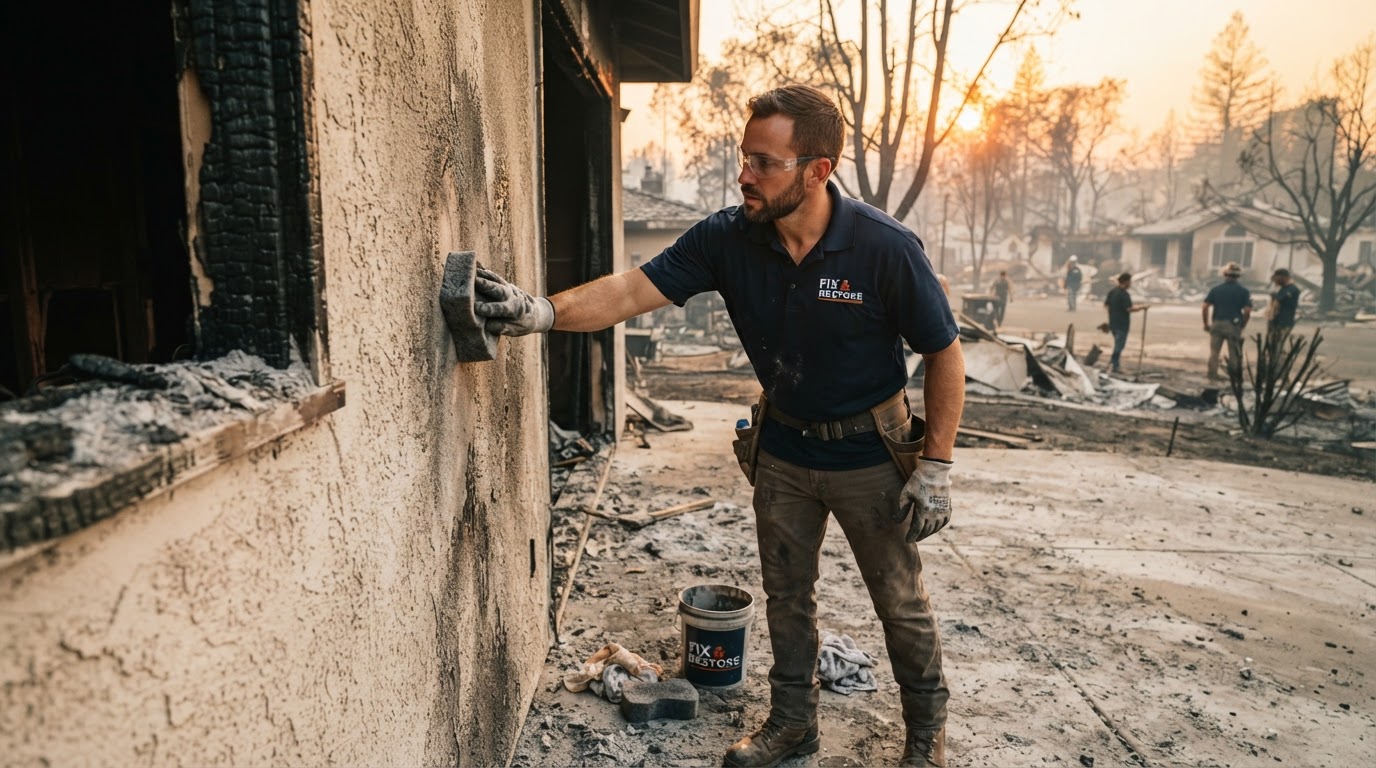
After the recent wildfires, ash and soot settled on homes across the San Fernando Valley. The instinct for many homeowners is to blast it off with a pressure washer.
That instinct is exactly wrong. Pressure washing drives soot and ash deeper into porous surfaces — stucco, wood, concrete — where it becomes nearly impossible to remove and continues to off-gas odor.
Why Pressure Washing Fails
Wildfire ash isn't just dust. It's a mix of fine particulates, charred organic material, and oily soot residues. Under high pressure, these particles are forced into the microscopic pores of your home's exterior.
Once embedded, the soot resists removal, stains the surface, and continues to release odor — sometimes for months.
- High pressure forces soot into pores rather than lifting it off.
- Oily residues bond to surfaces under pressure and heat.
- Water activates the odor compounds in soot, making the smell worse.
The Right Way to Clean Ash
The correct approach is dry removal first, then gentle wet cleaning only where needed.
- HEPA vacuuming of all horizontal surfaces to lift loose ash.
- Dry chemical sponging of vertical surfaces to lift soot without water.
- Targeted, low-pressure wet cleaning with specialized degreasers.
- HEPA air filtration to capture airborne particulates during cleaning.
"Pressure washing drives soot and ash deeper into porous surfaces where it becomes nearly impossible to remove."
Fix & Restore has helped many Valley families recover after the fires. We follow IICRC S740 standards for fire and smoke damage restoration, ensuring ash and soot are removed — not pushed deeper — so your home is truly clean and odor-free.