
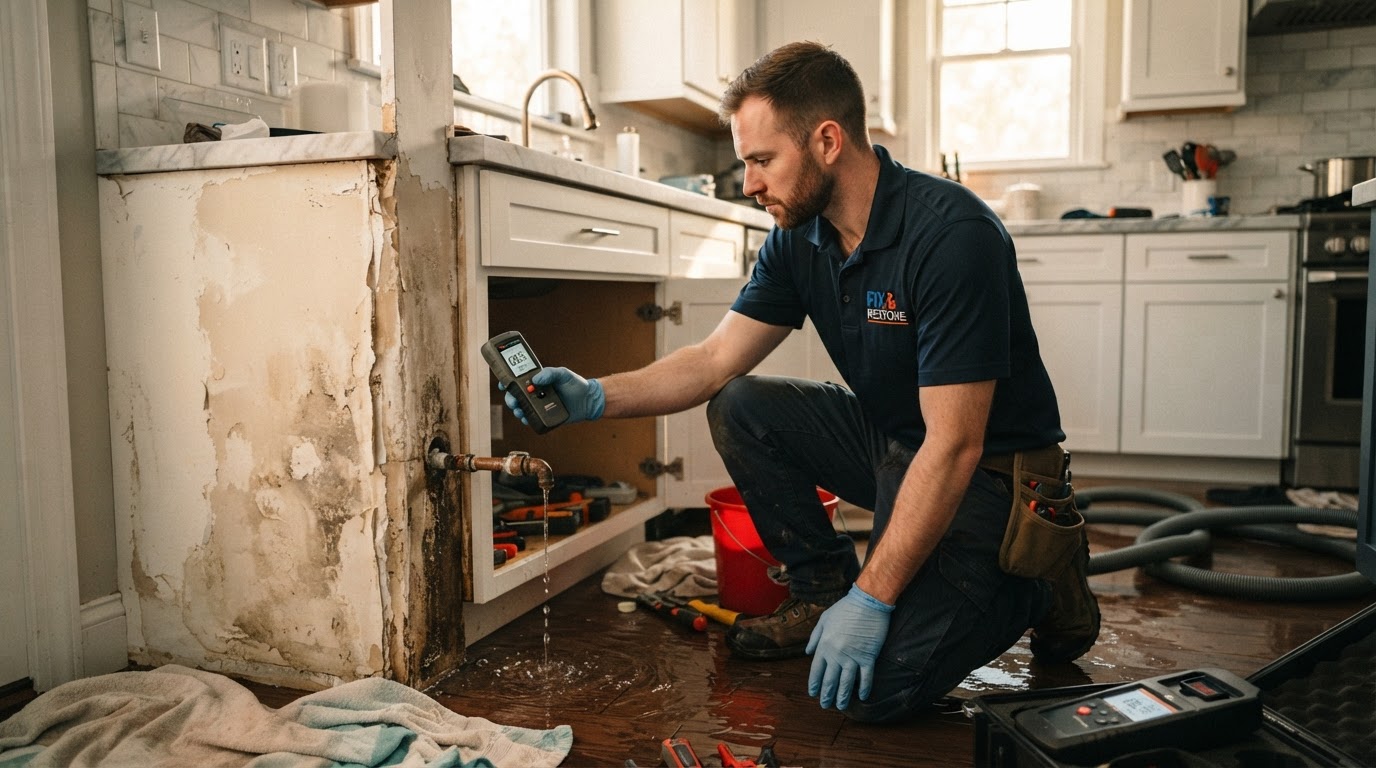
A small leak rarely feels like a full-blown emergency at first. Maybe it's a line rupture under the kitchen sink, an overflowing washing machine, a failed water heater, or a dark stain slowly spreading across your living room ceiling.
Whatever the cause, one rule governs every water loss: water damage is a progressive disaster. It gets exponentially worse with every hour that passes.
Too many property owners wait to act because the damage "doesn't look that bad" on the surface. Unfortunately, what you can physically see is usually less than 10% of the true problem.
At Fix & Restore, we see it every week: delaying mitigation by even 24 hours turns a simple drying project into a massive, invasive tear-out.
The 24-Hour Destruction Timeline
Water doesn't stay where it lands. Driven by gravity and capillary action, it actively migrates into porous building materials — soaking deep into drywall, subflooring, insulation, cabinetry, and structural framing within minutes.
- Minutes: Water spreads across surfaces and begins wicking into the bottom edges of drywall and baseboards.
- 1–4 hours: Finishes stain, carpet delaminates, and furniture finishes begin bleeding into fabrics.
- 24 hours: Drywall swells and disintegrates, metal surfaces tarnish, and a musty odor signals the start of microbial activity.
- 48+ hours: Mold colonies establish, structural wood warps, and the space becomes a biohazard remediation project.
The Invisible Mold Clock: 24 to 48 Hours
The biggest threat following a water loss isn't just structural warp — it's microbial growth.
Under ideal humidity and temperature conditions, mold spores germinate on wet drywall, wood, and carpet backing in as little as 24 to 48 hours.
Once mold takes root, simple water extraction is no longer an option. The job escalates to specialized containment, HEPA air filtration, biohazard remediation, and mandatory demolition — tripling your restoration timeline and costs.
"What you can physically see is usually less than 10% of the true problem."
What to Do in the First Hour
The single most important step is to stop the source and start extraction immediately. Every hour you wait, the scope of damage — and your out-of-pocket cost — grows.
Our crews are on call 24/7 and are typically on-site within 40 minutes of your call. We extract standing water, set industrial dehumidification, and begin moisture mapping to document the loss for your insurance carrier before secondary damage sets in.