
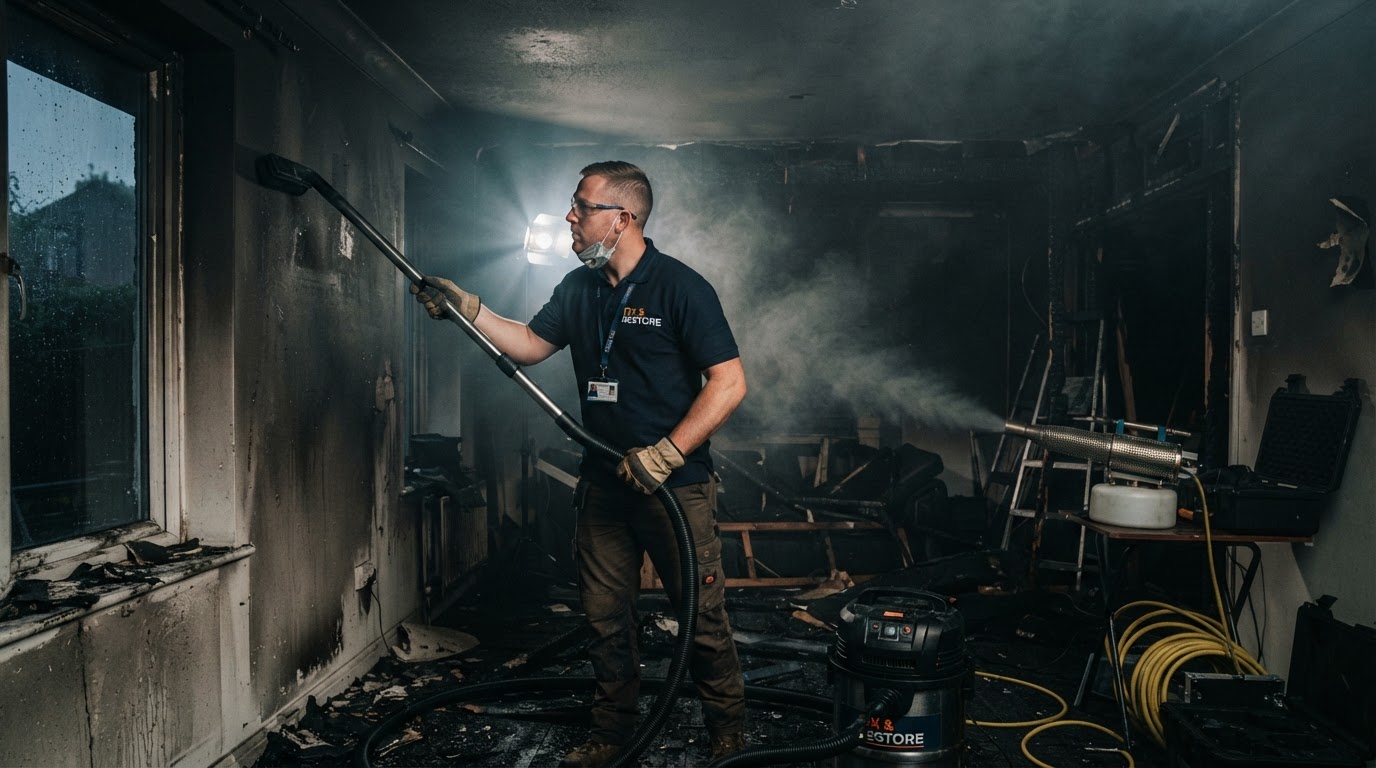
After a fire is out, the smoke is what lingers — sometimes for months or years. The smell isn't just on the surface; it's embedded in materials throughout the home.
Smoke particles are microscopic. They're smaller than a micron, which means they penetrate deep into porous surfaces: drywall, insulation, wood framing, HVAC ductwork, upholstery, and even behind electrical outlets.
Why DIY Cleaning Fails
Most homeowners reach for household cleaners and air fresheners. Both fail for the same reason: they only address the surface and the odor, not the source.
Wiping soot with a wet rag can actually make it worse by driving oily soot residues deeper into the material. Air fresheners mask the smell temporarily while the embedded soot continues to off-gas.
- Surface cleaning removes less than 20% of soot contamination.
- Wet wiping smears oily soot, making stains permanent.
- HVAC systems recirculate soot throughout the home if not professionally cleaned.
A True Smoke Remediation Protocol
Professional smoke remediation is a multi-step process designed to remove soot at the source and neutralize odor molecules rather than mask them.
- Dry chemical sponging to lift loose soot without smearing.
- HEPA vacuuming of all horizontal and vertical surfaces.
- Thermal fogging to neutralize odor molecules trapped in pores.
- Ozone treatment for deeply embedded smoke in enclosed spaces.
- HVAC duct cleaning and filter replacement to stop recirculation.
- Sealing of stained surfaces when removal isn't possible.
"Air fresheners mask the smell temporarily while the embedded soot continues to off-gas."
At Fix & Restore, we follow IICRC S740 standards for smoke and odor remediation. Our goal isn't just a clean-looking home — it's a home where the smoke is genuinely gone, verified with moisture and odor meters before we sign off.